For years, the global narrative around energy storage has been dominated by one chemistry: lithium-ion. It powers our phones, our electric vehicles, and an increasing number of homes with solar backups. But when the conversation shifts from powering a single household to stabilizing a national grid serving over 200 million people, the rules of the game change entirely. In Nigeria, a nation grappling with an erratic grid, ambitious renewable energy targets, and a rapidly growing population, the choice between Lithium-Ion vs. Flow Battery Technologies for Grid-Scale Applications is not merely an academic exercise—it is a multi-billion dollar decision that will shape the country’s industrial future for decades.
Recent policy moves, including the African Development Bank’s $500 million disbursement for power sector reforms and a feasibility study for a Nigerian Battery Energy Storage Systems (BESS) project , signal that Nigeria is ready to move beyond pilot projects. The government has set a target to integrate 4,200 MWp of solar PV into the grid by 2030, a goal that is technically impossible without massive grid-scale energy storage . However, the pressing question remains: which technology should anchor this ambitious program?
The Erratic Grid Dilemma: A Unique Nigerian Stress Test
To understand which battery technology is fit for purpose, one must first understand the environment in which it will operate. Unlike stable Western grids, the Nigerian national grid is notoriously volatile. It experiences frequent partial or total collapses, and power quality issues like frequency fluctuations and voltage sags are daily realities for transmission system operators.
A groundbreaking study conducted at Baze University, Abuja, and published in the journal Energy investigated exactly this scenario. Researchers simulated the impact of an erratic national grid on hybrid power systems and discovered something counterintuitive: the battery technology that performs best under steady-state conditions is not necessarily the winner when the grid becomes unpredictable . The study compared vanadium redox flow batteries (VRB), lead-acid, nickel-iron, and lithium-ion batteries (LIB). The results were striking. The VRB-based system delivered superior performance at the lowest net present cost ($6.3 million) and levelled cost of energy ($0.0722/kWh), despite having higher upfront losses. This suggests that in Nigeria’s unique operating environment, resilience to deep discharges and frequent switching may outweigh raw energy density.
Chemistry Clash: Understanding the Core Differences
Before diving deeper into the Nigerian context, it is essential to strip away the marketing hype and examine the fundamental engineering tradeoffs between these two contenders.
Lithium-Ion: The Agile Sprinter
Lithium-ion batteries are the reigning champions of energy density. They pack significant power into a relatively small footprint and respond to grid signals in milliseconds, making them exceptional for frequency regulation and short-term balancing. However, they come with inherent vulnerabilities. In a country like Nigeria, where ambient temperatures regularly soar, thermal management becomes a critical issue. Lithium-ion cells degrade with heat and cycling, and their functional lifespan is highly dependent on maintaining an optimal state of charge.
Flow Batteries: The Marathon Runner
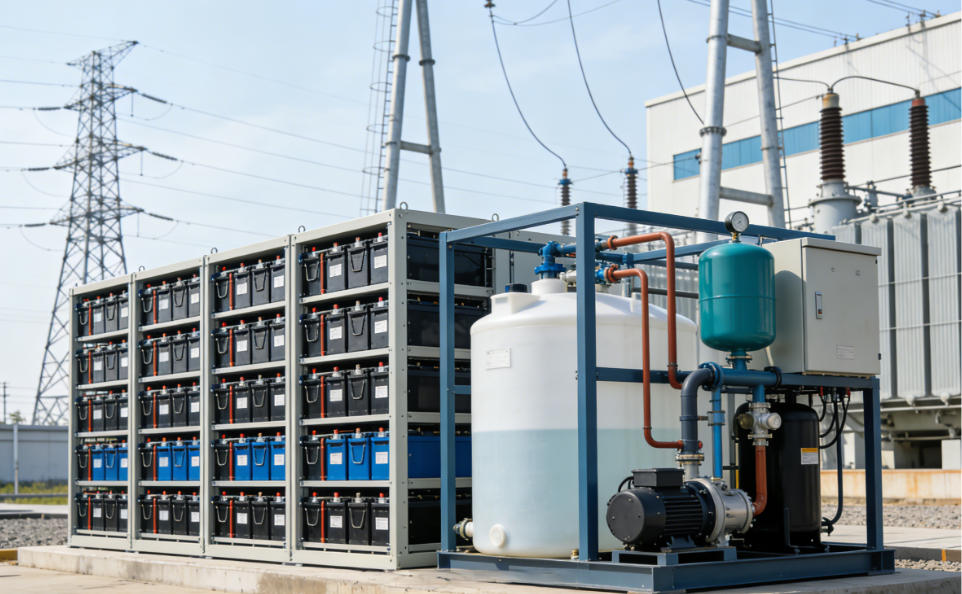
Flow battery technology, particularly vanadium redox, operates on a completely different principle. Energy is stored in liquid electrolytes contained in external tanks. This architecture decouples power (determined by the stack size) from energy capacity (determined by tank volume). For grid-scale applications, this is revolutionary. If a utility needs more storage duration, they simply add more electrolyte. The chemistry is also non-flammable, virtually eliminating fire risk, and the electrolyte does not degrade over cycles. A vanadium battery can be deeply discharged—cycled to 0% state of charge—without damaging the system. In a grid context where a major outage might require a complete system drain, this resilience is invaluable.
Techno-Economic Realities: What the Data Says for Nigeria
The theoretical advantages of flow batteries are compelling, but the Nigerian energy sector operates on razor-thin margins. The cost-benefit analysis must account for local realities: import dependencies, maintenance skill gaps, and the specific demands of integrating with Nigeria’s transmission infrastructure.
Recent research from Cranfield University provides a powerful data point. In a comprehensive techno-economic and environmental assessment of a proposed offshore wind farm near Koko Sea Port, researchers again identified Vanadium Redox Flow Batteries (VRFB) as the most suitable storage technology. The study modelled a system capable of storing 528 MWh to smooth the output of 477 wind turbines. The analysis went beyond simple capital costs to include lifetime performance. It concluded that while the Levelised Cost of Energy (LCOE) for the integrated project was $393.35/MWh—comparable to global benchmarks for new offshore wind—the environmental savings were profound. Compared to coal and gas plants, emissions were reduced by over 107% and 74% respectively.
This highlights a critical point often missed in policy discussions. The “cost” of storage is not just the purchase price. It is the cost of curtailment (wasted renewable energy), the cost of grid instability, and the cost of diesel backups. When these factors are included, the economic case for long-duration storage like flow batteries strengthens considerably.
Lifecycle Assessment: Beyond the First Decade
One of the most deceptive metrics in the battery industry is the “warranty period.” While a premium lithium-ion solar battery might boast a lifespan of 10 to 15 years or 6,000 to 8,000 cycles in ideal conditions, the reality in Nigeria’s urban centres can be harsher. A study on EV batteries in Lagos revealed that degradation is shaped more by driving behavior and usage patterns than by temperature alone, with batteries remaining viable down to 40-60% State of Health (SoH). This finding has profound implications for second-life applications, but it also underscores the complexity of predicting lithium-ion lifecycle assessment in uncontrolled environments.
Flow batteries offer a fundamentally different lifecycle profile. Because the electroactive materials are dissolved in solution rather than embedded in solid electrodes that physically strain during cycling, they do not suffer from the same structural degradation. A vanadium flow battery can theoretically operate for 20 to 30 years with minimal capacity loss. The electrolyte itself is essentially a perpetual resource; it can be reused or repurposed indefinitely. For a long-term national infrastructure project, this durability aligns better with the multi-decade financing models used by development banks like the AfDB.
The Policy Crossroads: Nigeria’s $500 Million Question
With the Transmission Company of Nigeria (TCN) now conducting feasibility studies for BESS deployment, and the Minister of Power explicitly highlighting the “grid-forming capability” of advanced storage systems, Nigeria stands at a policy crossroads.
The minister’s technical observation is crucial. Unlike traditional “grid-following” inverters that passively sync with the grid, “grid-forming” BESS can actively establish voltage and frequency references, acting as virtual power plants. This capability is essential for black starts and operating in island mode during grid collapses. While both lithium and flow batteries can be paired with grid-forming inverters, the inherent stability and longer discharge duration of flow batteries make them particularly suited for this “virtual generator” role.
Furthermore, market forecasts indicate that while lithium-iron phosphate currently dominates the Nigeria grid scale stationary battery storage market, other chemistries like sodium-sulfur and flow batteries are gaining traction for specific capacity segments. The key for Nigerian policymakers and regulators will be to avoid locking the country into a single technology pathway.
Strategic Recommendations: A Hybrid Path Forward
Given the evidence, a dogmatic “one-size-fits-all” approach would be a strategic error. Instead, Nigeria should consider a hybrid portfolio approach to grid-scale energy storage, leveraging the strengths of each technology for different grid services.
1. Deploy Lithium-Ion for High-Power, Short-Duration Needs: For primary frequency response and voltage regulation where millisecond response times are paramount, lithium-ion remains the superior choice. Its high power density and falling costs make it ideal for these ancillary service markets.
2. Prioritize Flow Batteries for Bulk Energy Shifting and Resilience: For the core task of shifting solar generation from midday to evening peaks—a key requirement for integrating 4,200 MWp of solar—flow batteries offer a better fit. Their ability to provide 6 to 10 hours of continuous discharge without degradation makes them perfect for this “energy shifting” role. The Baze University research, which showed VRB outperforming other chemistries in a real Nigerian hybrid system context, should not be ignored.
3. Develop a Localized Techno-Economic Assessment Framework: The global LCOE figures are useful benchmarks, but Nigeria needs its own assessment tools. The sensitivity analysis from the Abuja study clearly showed that the frequency and duration of grid outages drastically affect optimal system economics. Nigerian regulators and utilities should develop a localized valuation framework that accounts for the specific costs of grid unreliability, thereby capturing the full value stack that storage provides.
4. Invest in Workforce Development and Institutional Readiness: As noted by the TCN Managing Director, understanding the “institutional readiness, operational protocol and capacity building priority” is as important as the hardware . Flow batteries, while simpler electrochemically, require different maintenance skill sets than lead-acid or lithium systems. Building this expertise locally should be a priority under the AfDB technical assistance programmes.
Engineering for Resilience
The race to decarbonize Nigeria’s grid is not a sprint; it is an ultra-marathon. In such a race, pacing and durability often triumph over explosive speed. While lithium-ion batteries will undoubtedly play a significant role in the near term, the unique characteristics of flow batteries—their longevity, safety, scalability, and resilience to deep cycling—make them an increasingly attractive proposition for the country’s core grid infrastructure.
The teardown of the energy storage problem in Nigeria reveals a clear truth: the goal is not simply to install megawatts of batteries, but to build a resilient, flexible, and durable grid that can withstand the shocks of an erratic national system and the variability of renewable generation. As the TCN and Ministry of Power move from feasibility studies to procurement, the choice of technology will send a powerful signal about the kind of grid Nigeria intends to build for the next 30 years. The smart money is on a diversified portfolio that recognizes the distinct engineering tradeoffs of each solution, ensuring that when the sun sets or the wind stalls, the lights stay on.