The modern world is built on an assumption so fundamental that it is rarely spoken: when we flip a switch, the lights will turn on. This certainty is delivered by an immense, silent machine stretching across continents. While power plants capture the imagination, the true heavy lifting of electricity delivery is performed by the substation and transmission equipment that form the global grid’s skeleton and nervous system. This network is not merely a collection of passive conductors and insulators; it is a dynamic, intelligent, and often embattled system facing threats from aging infrastructure, extreme weather, and the complex demands of the energy transition. Understanding the architecture and guardians of this system is critical for ensuring a resilient and reliable energy future.
The High-Wire Act: Anatomy of the Transmission Network
The transmission system has been aptly described as the most complex machine humanity has ever built. Its primary mission is to move vast quantities of electrical energy over long distances—from remote generating stations to the urban and industrial load centers where power is consumed. To accomplish this with acceptable losses, the voltage is “stepped up” to extremely high levels, ranging from 138 kV to 765 kV and beyond. This high-voltage carriage reduces current for a given power level, minimizing heat loss and allowing for narrower rights-of-way.
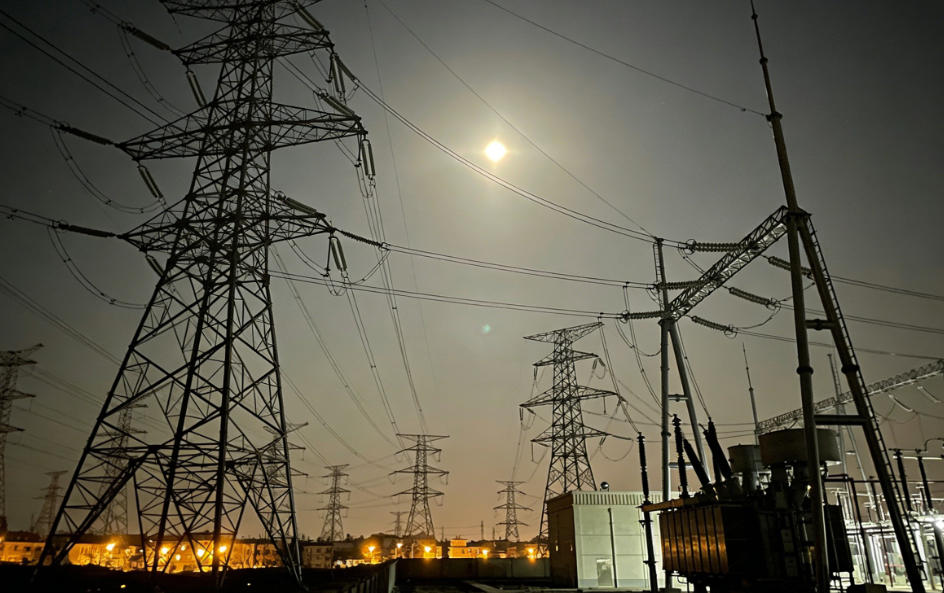
This network is composed of high-voltage power lines, typically strung from towering steel lattices, and the substations that act as critical nodes within the system. In dense urban environments where real estate is at a premium, these arteries may retreat underground as insulated cable systems. The power flow on these lines is not infinite; it is constrained by physical limits. Transmission line constraints are dictated by thermal limits (overheating the conductor), voltage stability (the line’s reactance causing voltage to drop at the far end), and transient stability (the ability to keep generators in sync after a disturbance). These constraints are the root cause of transmission congestion, where low-cost power cannot reach consumers because the physical infrastructure is maxed out .
Substation & transmission equipment
The Primary Citadel: Power Transformers and Switchgear
A substation is far more than a fenced-in field of equipment. It is a fortress where voltage is transformed, power flow is directed, and the health of the grid is monitored. The equipment within is broadly classified into two categories: primary and secondary. Primary substation equipment is the high-voltage apparatus directly involved in the power transfer.
Power Transformers: The Heart of the Substation
The most iconic and vital piece of equipment in any substation is the power transformer. This static device uses electromagnetic induction to convert electrical energy from one voltage level to another at the same frequency. In a typical power delivery chain, a generator produces power at 10–30 kV. A step-up transformer at the generating station raises this voltage to transmission levels (e.g., 345 kV). As the power approaches a city, a series of step-down transformers at distribution substations gradually reduce the voltage to safer levels suitable for industrial feeders and residential neighborhoods.
Transformer reliability is paramount, as a failure here can strand massive amounts of power for weeks or months while repairs or replacements are sourced. Modern units are complex assemblies requiring robust cooling systems—often using oil for insulation and heat dissipation—and sophisticated protection schemes. Yet, maintenance of these critical assets is frequently deferred. Real-world grid data reveals alarming trends: in some systems, over 62% of transformers have missed their maintenance cycles, and a staggering 66% of tap changers—the mechanical devices that regulate voltage under load—are overdue for servicing, with some having gone decades without proper attention. This accumulated deterioration represents a significant, hidden vulnerability in the grid.
Circuit Breakers and Disconnect Switches
To control and protect the grid, a substation relies on a suite of switching devices. Circuit breakers are the heavy artillery of the system. Under normal conditions, they switch load currents on and off. In the event of a fault (like a lightning strike on a line), they work in concert with protective relays to rapidly interrupt the massive fault current, isolating the problem and preventing catastrophic damage to equipment and widespread outages. High-voltage breakers are engineered with arc-extinguishing capabilities, using media like SF6 gas or vacuum to quench the electrical arc that forms when contacts separate.
Working alongside breakers are disconnect switches, or isolators. These are mechanical devices with no arc-extinguishing capability; they cannot interrupt load current . Their function is strictly for safety and isolation. After a breaker has opened a circuit, a disconnect switch provides a visible air gap to ensure that a section of the line or a piece of equipment is physically separated from the live grid, allowing maintenance crews to work safely.
Supporting these major assets are instrument transformers—Current Transformers (CT) and Potential Transformers (PT) . These devices scale down the high voltages and massive currents of the primary system to safe, standardized low values (typically 100V or 5A) that can be fed to meters, relays, and control systems . They provide the critical isolation and sensing needed for all secondary functions.
The Digital Guardians: Protection, Control, and Automation
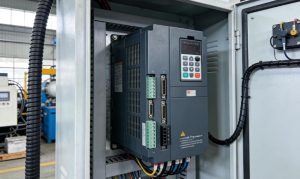
If primary equipment is the body of the substation, the secondary equipment is its brain and nervous system. These low-voltage devices perform the essential tasks of monitoring, control, and protection, ensuring the primary system operates safely and reliably .
The Role of Protective Relays
The most critical guardians within this secondary world are protective relays. These automatic devices are constantly on watch, sensing current, voltage, and frequency via CTs and PTs. They are designed to detect faults or abnormal operating conditions—such as a short circuit, an overload, or an unstable voltage—and respond by tripping circuit breakers or issuing alarms .
The performance of a protection system is judged by four fundamental requirements :
-
Selectivity: The relay must be smart enough to isolate only the faulty component, leaving the rest of the healthy system energized.
-
Speed: Faults must be cleared as fast as possible, often within 0.06 to 0.12 seconds, to maintain system stability, minimize damage, and reduce safety risks.
-
Sensitivity: The relay must be sensitive enough to detect even the most minimal fault conditions within its designated zone.
-
Reliability: This is the most basic requirement. The protection must operate when it is supposed to, and must not operate when it is not supposed to.
The importance of this equipment cannot be overstated. In recent large-scale grid stabilization efforts, utilities have prioritized maintenance on protection and control equipment, performing work on thousands of devices. These interventions are critical because these “invisible guardians” are essential for detecting faults and protecting both infrastructure and service continuity.
Testing and Automation
To ensure reliability, protection relays must themselves be tested. This is the domain of specialized tools like the protection relay tester, which simulates various fault conditions (short circuits, overvoltages, etc.) to verify that the relay responds correctly and within its specified time. These testers are becoming increasingly intelligent, multifunctional, and portable, enabling more rigorous field testing.
Modern substations are increasingly automated, relying on Supervisory Control and Data Acquisition (SCADA) systems for remote monitoring and control, making them largely unattended. This automation extends to intelligent electronic devices (IEDs) and communication networks that allow for rapid coordination between substations and central control centers.
The Vulnerability Paradox: Maintenance and Resilience
Despite the sophistication of modern equipment, the grid faces a fundamental paradox: it is aging and often under-maintained, yet expected to perform with near-perfect reliability under increasingly stressful conditions. The consequences of deferred maintenance are stark. Analysis has shown that a significant percentage of distribution and transmission breakers are overdue for maintenance, creating a backlog of reliability debt.
This maintenance gap is exacerbated by external threats. Extreme weather events—hurricanes, wildfires, ice storms—are the leading cause of major outages, and their frequency and intensity are rising. When aging components, poor maintenance, and high operating stresses combine with severe weather, the probability of cascading failures increases dramatically. Power system reliability is, therefore, not a static state but a dynamic battle against probabilistic failure, requiring sophisticated risk management and predictive tools like Poisson distribution to forecast outage patterns.
The Future Grid: Resilience by Design
Responding to these challenges requires a fundamental shift in philosophy, moving from reactive repair to proactive resilience. This is being addressed on several fronts.
Designing for Inspection and Maintainability
One of the most practical shifts is the move to design substations for inspection from day one. Historically, equipment was designed for capacity, with maintenance access as an afterthought. Today, engineers are embedding inspection access directly into the infrastructure. This includes installing infrared (IR) windows on switchgear to allow for thermal imaging of connections without opening energized panels—a practice that dramatically reduces arc flash risk. It also includes adding acoustic ports for ultrasound detection of partial discharge, and even passive indicators like thermochromic labels that change color when components overheat. Designing for maintainability transforms substations from vulnerable points of failure into resilient, manageable assets.
Research and Advanced Engineering
At the highest levels, research institutions are dissecting failure modes to build better infrastructure. The Electric Power Research Institute (EPRI) conducts studies on foundational elements like the frequency of geotechnical soil borings for transmission towers, quantifying the error introduced when soil parameters are assumed rather than measured. Other research focuses on understanding “longitudinal security loads”—the dynamic forces exerted on towers when a conductor breaks—to design structures that can withstand such events and prevent catastrophic cascades. Every structural failure offers a lesson, and the industry is increasingly using case studies to improve engineering standards.
The Great Energy Transition
Finally, the grid must adapt to new demands. The widespread integration of renewable energy sources and the push for electrification are changing how the transmission and distribution system is used. Substations are no longer just passive nodes; they must handle bidirectional power flows from distributed solar, manage the intermittency of wind, and support the fast-charging infrastructure for electric vehicles . This requires modernizing protection schemes, upgrading control systems, and ensuring that the foundational transmission and distribution equipment is robust enough to handle this new, more dynamic operating environment.