In the global race to generate more electricity, the spotlight often falls on megawatt capacity or fuel sources. Yet, the true determinants of a power plant’s profitability, safety, and longevity lie not in its nameplate capacity, but in the intricate network of power plant equipment and systems operating behind the scenes. These components form a complex industrial ecosystem where mechanical stress, thermal dynamics, and digital intelligence converge. Understanding this hidden architecture is essential for engineers, investors, and policymakers aiming to navigate the energy transition without compromising grid stability.
The Trinity of Power Generation: Boiler, Turbine, and Generator
At the heart of any thermal power plant—whether fueled by coal, gas, or nuclear fission—lies the inseparable trio of boiler, turbine, and generator. These three elements constitute the primary motion machinery, and their interdependency dictates the plant’s overall efficiency.
High-Efficiency Boilers and Pressure Systems
Modern boilers have evolved far beyond simple steam drums. In coal-fired facilities, the adoption of high-efficiency boilers has become a strategic imperative. Traditional subcritical boilers typically operate at thermal efficiencies between 33% and 37%, but advanced supercritical and ultra-supercritical designs now exceed 45% efficiency. This leap is achieved by operating at temperatures above 600°C and pressures exceeding 25 MPa.
The pressure systems within these boilers—including superheaters, reheaters, and economizers—are engineered from high-strength alloys capable of withstanding extreme thermal cycling . However, efficiency gains come with heightened risks. Instability in pressure can lead to thermal fatigue, corrosion, and catastrophic failure. Therefore, real-time monitoring of coal-fired power plant boiler pressure systems is non-negotiable, relying on predictive analytics to maintain operational integrity.
Turbine Control and Protection
While the boiler generates steam, the turbine translates thermal energy into rotational force. Turbine control and protection systems are often overlooked during routine operations, yet they are as critical as the rotating blades themselves. These systems age imperceptibly, and when they malfunction, the result is immediate production disturbances.
Effective turbine governance involves electro-hydraulic control systems, thermal stress evaluators, and sophisticated protection logic that monitors vibration, temperature, and shaft alignment. Integrating these controls into plant-wide automation systems enhances decision-making and allows for early warning of nascent failures. The generator, synchronized with the turbine, demands equally rigorous oversight, including stator insulation monitoring, rotor balancing, and excitation control.
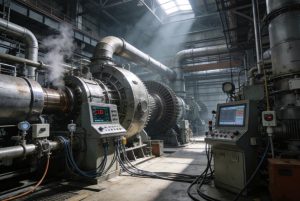
Power plant equipment and systems
Balance of Plant: The Unsung Hero of Reliability
The term balance of plant encompasses all auxiliary systems that support the primary generation cycle. These subsystems—ranging from feedwater heaters to coal handling mechanisms—are frequently the root cause of unplanned outages when neglected.
Electrical Balance of Plant (EBoP)
According to NERC statistics, three of the top ten causes of power plant outages are attributable to electrical equipment failure. The Electrical Balance of Plant includes the grid connection, switchyard, emergency power systems, and all electrical distribution networks within the facility. Unlike rotating machinery, electrical systems often lack redundancy; a single failure in the generator-to-substation link can halt production entirely.
Modern EBoP service strategies emphasize life-cycle management. Rather than replacing entire systems, engineers now retrofit aging components—such as upgrading automatic voltage regulators on excitations while retaining the core power electronics. This approach minimizes outage duration and capital expenditure while extending asset life.
Fluid Handling and Thermal Exchange
Beyond electricity, power plants are massive fluid processing facilities. Boiler feed pumps, condensate extraction pumps, and cooling water systems must operate with precision. The condenser, often located directly beneath the low-pressure turbine, maintains vacuum conditions essential for thermal efficiency. Any degradation in condenser performance directly impacts output.
SPX”s concept of “Cold-end Optimization” illustrates the importance of holistic design. The cooling tower, condenser, and steam turbine must be engineered as an integrated system rather than individually procured components. When these elements are mismatched, the plant suffers from chronic inefficiency that no amount of operational tweaking can correct .
Control Systems and Instrumentation: The Digital Nervous System
In the era of Industry 4.0, power plant control systems have transitioned from simple electromechanical relays to distributed digital architectures. These systems are not merely support tools; they are assets that produce added value by optimizing combustion, managing emissions, and enabling flexible operation.
From DCS to Predictive Analytics
The Distributed Control System (DCS) serves as the plant’s central nervous system, integrating data from thousands of sensors monitoring pressure, temperature, flow, and vibration. Advanced systems now incorporate artificial intelligence to optimize processes, particularly in plants with variable fuel quality like biomass or waste-to-energy facilities. AI can either recommend control adjustments or directly manipulate setpoints to maintain peak efficiency.
Condition monitoring has evolved from periodic manual rounds to continuous surveillance. Vibration analysis on turbine-generator bearings, oil quality monitoring, and thermal imaging of electrical switchgear allow maintenance teams to predict failures before they occur. This predictive approach reduces unplanned outages and extends equipment lifespan.
Safety and Protection Interlocks
Protection systems operate independently from control systems, providing a final layer of defense against catastrophic failure. Boiler safety includes flame scanners, drum level interlocks, and overpressure protection. Turbine protection involves overspeed trip mechanisms, thrust bearing monitoring, and emergency stop valves -1. These systems must be tested regularly, as undetected faults can render them inoperative when most needed.
Maintenance Strategies: Preserving Asset Integrity
No discussion of power plant equipment is complete without addressing maintenance. The intense thermal, mechanical, and chemical stresses imposed on components necessitate structured upkeep programs.
Preventive, Corrective, and Predictive Approaches
Preventive maintenance follows fixed schedules—cleaning, lubrication, and part replacement based on operating hours. Corrective maintenance addresses unexpected failures, requiring rapid diagnosis and repair. Predictive maintenance, the most advanced tier, leverages real-time data to forecast deterioration and schedule interventions optimally.
Non-destructive testing techniques such as radiography, ultrasonic testing, and magnetic particle inspection are employed during outages to detect hidden defects in high-pressure components. For aging plants, strategic retrofitting during repair phases can enhance performance and extend operational life, offering a cost-effective alternative to new construction.
RAM Analysis in Hydropower
While thermal plants dominate headlines, hydropower remains the backbone of renewable generation. Reliability, Availability, and Maintainability (RAM) analysis is critical for hydro facilities, where turbine, governor, and generator failures can disrupt grid stability. Tools like Failure Mode Effect Analysis (FMEA) and Fault Tree Analysis (FTA) help identify critical failure modes and prioritize maintenance interventions. The results guide operators in scheduling maintenance to maximize availability while minimizing costs.
Future Directions: Simulation and Digital Twins
As power plants face increasing pressure to operate flexibly—ramping up and down to accommodate renewable intermittency—traditional design approaches fall short. Transient simulation tools now allow engineers to model plant behavior under dynamic conditions before implementing control logic or hardware changes.
Power Plant Transient Simulation
Toolkits like PPTS enable virtual commissioning of control systems, analysis of startup and shutdown transients, and evaluation of equipment trips. These simulations support everything from component sizing to operator training, reducing the risks associated with real-world testing. For solar-thermal and oxy-combustion plants, simulation helps optimize performance across varying weather conditions and load demands.
The Path Toward Decarbonization
Even as renewables expand, existing thermal assets must operate efficiently to ensure grid reliability. High-efficiency boilers, advanced emission controls, and carbon capture integration will define the next decade of coal and gas plant operations. Simultaneously, digitalization—through AI, IoT, and predictive analytics—will unlock new levels of performance from aging infrastructure.
Conclusion
The machinery of power generation is far more than steel and copper. It is a sophisticated assembly of thermodynamic systems, electrical networks, and digital intelligence. For industry professionals, mastering the nuances of power plant equipment and systems is not merely an academic exercise—it is the foundation of reliable electricity supply. As the energy landscape transforms, those who understand the hidden architecture of these facilities will lead the transition toward a more resilient and sustainable grid.