Nigeria Renewable Energy Market 2026: The Dawn of a Cohesive Industry
By Energy & Policy Desk · February 24, 2026
LAGOS – For decades, Nigeria’s power sector was a synonym for entropy: a collapsing grid, expensive diesel fumes, and donor-driven pilot projects that never scaled. 2025 changed that narrative forever. Backed by the Electricity Act 2023, a wave of local manufacturing, and the largest naira-denominated debt facilities in history, the Nigeria renewable energy market has pivoted from fragmentation to industrial cohesion. This 2026 deep-dive dissects the numbers, the policies, and the capital that are reshaping Africa’s largest economy—and what comes next.
Market Size & Trajectory: From 3.6 GW to 14 GW by 2031
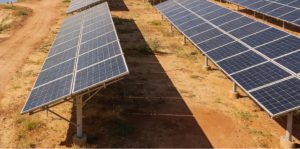
According to the latest Nigeria Renewable Energy Market Report 2026–2031, the nation’s installed renewable capacity reached 3.59 GW in 2025 and is projected to hit 14.07 GW by 2031, expanding at a blistering CAGR of 25.58%. Solar energy accounted for the lion’s share of new builds. In 2025 alone, Nigeria added 803 MW of solar capacity—a staggering 141% year-on-year surge—propelling the country to become Africa’s second-largest solar market after South Africa. Off-grid systems dominated this expansion, representing roughly 96% of the new capacity, as businesses and households abandoned diesel generators for hybrid PV+battery solutions.
The Manufacturing Breakthrough: From Importer to Exporter
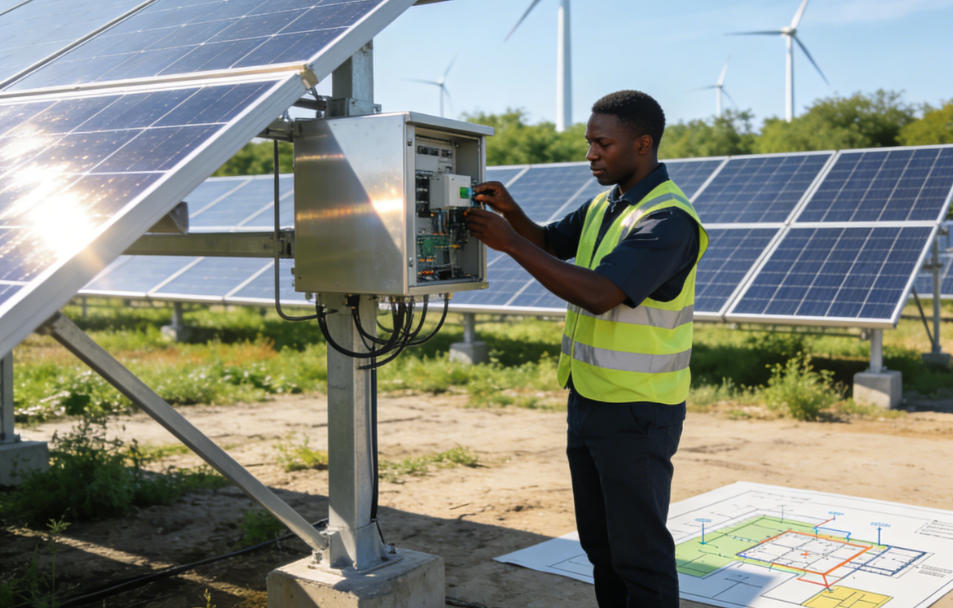
The most consequential shift in 2025 was the rise of local assembly and manufacturing. For years, Nigeria imported finished solar panels, retaining little economic value. Data from the Rural Electrification Agency (REA) now tells a different story: between January and November 2025, the country imported 110 MW of solar cells but only 82 MW of finished panels. That gap signifies a booming local assembly ecosystem, where firms like Auxano Solar—now boasting IEC 61215 and 61730 certifications—are turning cells into modules, keeping 60–70% of the value (frames, glass, lamination, labour) inside Nigeria.
In a landmark move for West Africa, Nigeria began exporting made-in-Nigeria solar panels to Ghana in late 2025, leveraging newly commissioned capacity that aims to hit 4 GW annually. “The beginning of Nigeria’s participation in regional renewable energy markets,” as Power Minister Bayo Adelabu described it, positions the country as a future manufacturing hub for the entire ECOWAS bloc.
Policy & Regulation: The Electricity Act 2023 Comes of Age
Policy certainty in 2025 moved from paper to practice. The Electricity Act 2023 empowered more states to establish their own electricity regulatory commissions, creating sub-national markets for distributed generation. At the federal level, NERC maintained a coordinating role to prevent fragmentation. The DARES programme (Distributed Access through Renewable Energy Scale-up), backed by a $750 million World Bank facility, sharpened its incentives for local content, rewarding developers who use Nigerian-assembled components.
Complementing these, the National Industrial Policy 2025 explicitly targets energy bottlenecks. It mandates that industrial clusters adopt solar hybrids, backs Independent Power Projects within manufacturing zones, and pushes for 25% renewable energy in the national mix by 2030. Lease-to-own models and long-term PPAs are now official government strategy to shield manufacturers from grid epilepsies.
Financing Evolution: Local Currency, Programme-Scale Capital
If 2024 was about pilot transactions, 2025 was the year of programmatic, local-currency finance. Banks and funds moved decisively:
- United Capital deployed a ₦5 billion (~$3.4 million) revolving facility to Husk Power Systems—the largest naira-denominated mini-grid debt to date.
- InfraCredit guaranteed CEESOLAR’s off-grid project in November 2025 via its Clean Energy Funding Programme, following its 2024 Green Sukuk for Prado Power.
- FCMB partnered with the REA on a ₦100 billion credit programme targeting two million households.
- Sterling Bank extended 48-month loans with Sun King, while All On closed a $3 million bridge round for Arnergy and a ₦2 billion investment in Salpha Energy.
On the international stage, President Bola Tinubu launched a $2 billion National Climate Change Fund at the Abu Dhabi Sustainability Week in January 2026. The fund aims to blend public and private capital, de-risking renewable infrastructure. Oversubscribed green bonds—Lagos State’s bond was nearly 98% oversubscribed—signal strong investor appetite.
Technology Trends: Solar, Storage, and the C&I Boom
While hydropower (mostly legacy dams like Zungeru) still accounts for about 87% of the cumulative renewable mix, its share is set to decline as wind and solar scale. Wind capacity is projected to grow at a 87.24% CAGR from a small base, driven by northern corridors with capacity factors above 35%. Yet the real action is in solar-plus-storage.
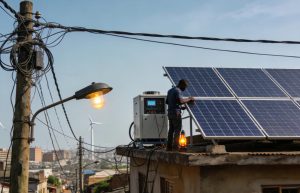
Battery storage exploded in 2025: installed capacity jumped from ~10 MWh to 40.6 MWh, a 305% increase. Plunging global lithium prices—battery packs fell to $112/kWh in Africa in 2025—coupled with rising diesel costs (subsidies are being phased out) make round-the-clock solar affordable. Commercial & Industrial (C&I) users are driving this: projects in the 5 MW to 10 MW range reached financial close in 2025, serving factories, telecom towers, and data centres. Energy-as-a-service and lease-to-own models, pioneered by firms like Earthbond and Rivy, are de-risking adoption for SMEs.
Challenges: Grid, FX & the Unfinished Agenda
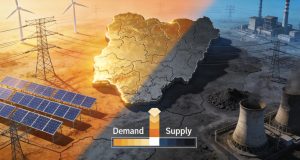
Despite the momentum, the Nigeria renewable energy market faces headwinds. The national grid still bleeds with transmission losses above 20%, and only 21% of wholesale invoices were settled in 2024—a systemic ill that forces heavy reliance on off-grid solutions. Foreign exchange shortages have eased thanks to 2025 reforms, but import duties on inverters and batteries remain a friction point. Regulatory fragmentation looms as some states draft their own rules, potentially creating a patchwork that deters investors.
Furthermore, financing volumes, though improved, are still far from the estimated $9.2 billion annual market potential. Most deals remain small-scale; the sector needs deeper institutional capital, securitisation, and blended finance vehicles to reach universal access.
Outlook 2026–2030: Cohesion and Industrialisation
The directional shift is unambiguous. 2025 was the inflection point where Nigeria’s renewable energy sector began to behave like a durable industry rather than a collection of donor experiments. With local manufacturing now a reality, battery storage scaling rapidly, and programme-based finance taking root, the foundations for a decentralised, resilient energy future are laid.
If the government sustains macroeconomic stability and states align their regulations, the Nigeria renewable energy market could not only meet its 2030 target of 25% renewables but also become the manufacturing and innovation hub for West Africa. As one industry leader noted, “Power means growth. No power, no growth.” In 2026, for the first time, Nigeria is building that power from within.