Nigeria, Africa’s largest economy, faces a stark energy paradox: despite massive licensed power projects and abundant resources, chronic blackouts persist, forcing a costly reliance on private generators and stalling national growth. For a nation of over 200 million people, the core metric of power failure is glaring. While the total installed capacity of grid-connected power plants is approximately 13,625 megawatts (MW), the actual available capacity in early 2026 was a mere 4,901 MW, with an average generation of just 4,421 MWh/h. This means nearly two-thirds of the existing generation infrastructure sits idle, operating at an abysmal 36% availability factor. This gap between potential and reality is the defining crisis of Nigeria’s power sector, costing the economy an estimated $29 billion annually and crippling productivity.
🔍 The Core Contradiction: Ambition vs. Reality
At the heart of Nigeria’s energy crisis is a profound disconnect between regulatory ambition and practical implementation.
· Licensing Boom vs. Stagnant Generation: Between 2017 and 2025, the Nigerian Electricity Regulatory Commission (NERC) issued over 645 licenses and permits for new generation projects, with a total licensed capacity exceeding 14,000 MW. However, this licensing boom has not translated into tangible power. Actual on-grid generation has remained flat, rarely exceeding 4,800 MW, as most licensed projects remain unbuilt due to financing challenges, fuel constraints, and grid limitations.
· A Shrinking, Not Expanding, Grid: Contrary to expansion goals, the available on-grid generation capacity has actually declined from a peak of ~8,000 MW in 2019 to ~5,400 MW by early 2025. This indicates that the grid is contracting to match its own severe transmission and distribution constraints, rather than growing to meet a latent national demand estimated to exceed 20,000 MW.
📈 Market Dynamics: Decentralization as a Symptom and Solution
Faced with grid unreliability, the market is organically pivoting towards self-reliance, reshaping the energy landscape.
1. The Rise of Decentralized & Captive Power
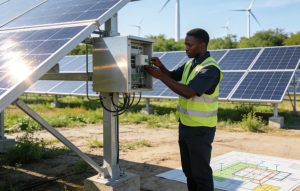
Businesses and industries are losing confidence in the national grid. This is evidenced by a sharp increase in permits for captive generation (dedicated power for industrial plants) and off-grid mini-grids, which accounted for most new projects licensed in 2023 and 2025. Companies are investing in solar-hybrid and natural gas systems to ensure operational continuity, representing a critical resilience strategy but also a sign of systemic fragmentation.
2. The Solar Market’s Mixed Signals
Nigeria’s solar potential is immense, with average daily radiation of 5.5-6.5 kWh/m². Market drivers are strong: falling global solar panel prices, innovative pay-as-go financing, and high commercial diesel costs (over $0.30/kWh) make solar economically attractive. However, growth is tempered by challenges like foreign exchange shortages, import duties on equipment, and regulatory uncertainty. The market is projected to grow at a compound annual growth rate (CAGR) of 25.58%, from 4.51 GW in 2026 to 14.07 GW by 2031.
3. The Persistent Gas Dilemma
Despite global energy transition trends, natural gas remains dominant in Nigeria’s energy mix, accounting for about 79.5% of grid electricity generation. Ironically, the country, which holds Africa’s largest gas reserves, suffers from chronic gas supply shortages to its power plants due to pipeline vandalism, commercial disputes, and inadequate infrastructure. Fixing this “broken gas-to-power value chain” is a immediate priority to unlock existing thermal plants.
🗺️ The Path Forward: Integration, Investment, and Equity
Solving Nigeria’s power crisis requires moving beyond simply licensing more projects to implementing deep structural reforms.
1. Modernizing the Grid and Unlocking Existing Capacity
The most urgent need is to fix what already exists. As energy analyst Chinedu Okafor notes, “Nigeria doesn’t necessarily need more power plants right now. It needs to fix the ones it already has”. Improving the average plant availability factor from 36% to even 60% could add approximately 3,000 MW to the grid overnight without new construction. This requires securing gas supply, modernizing the transmission network (currently constrained to wheeling about 5,500 MW), and investing in real-time grid management systems.
2. Strategic Integration of Decentralized Systems
The growth of mini-grids and captive power should not be seen merely as a workaround but as a component of a future Integrated Energy System (IES). The 2023 Electricity Act, which devolves regulatory power to states, is a key opportunity. States can create frameworks to integrate these decentralized systems into local grids, improving overall resilience and access. This aligns with research indicating that renewables could meet nearly 60% of Nigeria’s energy demand by 2050 through a diversified, integrated approach.
3. Ensuring an Equitable and Just Transition
Current investment is geographically skewed, with the South West and South South receiving over 75% of licensed capacity, while the North East and North West—regions with high energy poverty and excellent solar resources—are left behind. A just transition requires deliberate policy to redirect incentives and investments to these underserved regions, ensuring that energy access and its economic benefits are distributed equitably.
4. Mobilizing Capital and Building Confidence
The government has announced reforms aimed at attracting investment, including the implementation of the Petroleum Industry Act (PIA) and plans for a $1 billion domestic green bond issuance in 2026. The key to unlocking capital is demonstrating project bankability. This means enforcing cost-reflective tariffs, honoring power purchase agreements (PPAs), and providing de-risking instruments to attract the private investment needed to bridge the colossal generation gap, which a University of Nigeria study estimates requires adding over 100,000 MW of capacity by 2040.