The Great Turbine Transformation: Why 2026 is the Defining Year for Heavy-Duty and Aeroderivative Power
The NNEPIE Chronicle
For three decades, I have watched this industry oscillate between boom and bust, but the velocity of change we are witnessing in 2026 is unprecedented. The landscape for gas and steam turbines is not merely evolving; it is undergoing a fundamental metamorphosis driven by the trilemma of energy security, decarbonization, and the insatiable power demands of the digital age. The era of simply selling a box rated at 1MW to 500MW is over. Today, the conversation is about flexibility, hydrogen readiness, and the hybridization of the grid.
The Great Dichotomy: Aeroderivative Agility vs. Heavy-Duty Reliability
The market is polarizing, and understanding the distinct roles of technology platforms has never been more critical for investors and operators. On one side, we have the aeroderivative gas turbines, the jet engine descendants that are now the darlings of the grid stability crowd. Their value proposition is no longer just about power-to-weight ratio; it is about speed. In markets saturated with intermittent renewables, assets that can achieve full load in under ten minutes are not just convenient—they are essential for frequency response.
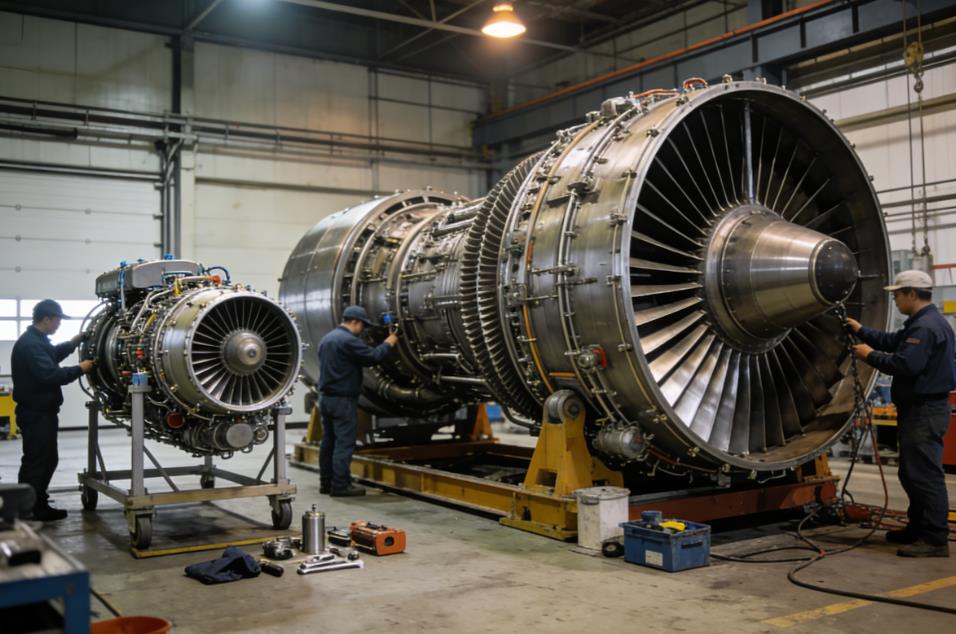
Conversely, the heavy-duty gas turbines remain the formidable backbone of baseload power, particularly in the rapidly industrializing economies. These machines, often exceeding 300MW, are engineered for a different kind of marathon. They are no longer just about brute force; the modern heavy-duty frame is a masterpiece of materials science, featuring single-crystal superalloy blades and thermal barrier coatings that withstand inlet temperatures exceeding 1,500°C. The competition between the OEMs—GE, Siemens Energy, Mitsubishi Power, and Ansaldo Energia—is no longer purely about raw output, but about who can offer the highest combined-cycle efficiency and the lowest lifecycle cost in the face of fluctuating demand.
Combined Cycle and CHP: The Efficiency Imperative
In the realm of large-scale power generation, the combined cycle plant remains the gold standard. By capturing the exhaust heat from a gas turbine to drive a steam turbine, these facilities routinely achieve efficiencies exceeding 60%. This thermodynamic symbiosis, meticulously optimized in modern Heat Recovery Steam Generators (HRSG) , effectively squeezes every possible joule from the fuel.
However, the real story in distributed infrastructure is the resurgence of Combined Heat and Power (CHP) and industrial self-generation. We are seeing a global shift where industries—from paper mills in New England to automotive plants in Shanghai—are rejecting the vulnerability of the grid. They are deploying turbine-based CHP solutions to secure their energy future. These facilities are no longer just about saving money; they are about guaranteeing operational continuity. By generating electricity on-site and utilizing the thermal effluent for process steam or district heating, industrial players are achieving fuel utilization rates that can approach a staggering 93%.
The Hydrogen Pivot: Future-Proofing the Fleet
The single most critical factor dominating boardroom discussions in 2026 is the “H2-ready” status of new assets. The financial risk of stranded assets is too high to ignore. This is where the technical depth of the major OEMs is truly tested.
Siemens Energy’s blueprint for the Leipzig Süd CHP plant serves as the global case study for this transition. This facility, utilizing SGT-800 turbines, is designed not just for today’s natural gas but for tomorrow’s hydrogen economy. Certified by TÜV Süd, the plant’s foresight in planning for a hydrogen pipeline connection, selecting explosion-proof components to handle hydrogen’s molecular volatility, and reserving space for future inertization systems, sets a new benchmark. It demonstrates that future-proofing is a design philosophy, not just a marketing term.
The technical hurdles are immense. Hydrogen combustion presents a trio of challenges: controlling higher flame reactivity to prevent damaging flashback, mitigating material embrittlement, and managing NOx emissions, which can be notoriously difficult to measure accurately in hydrogen blends. The leaders in this space, including Mitsubishi Power and Ansaldo, are leveraging additive manufacturing to create complex burner geometries with integrated cooling channels, allowing them to tame the hydrogen flame. This is the new frontier of the gas turbine industry.
Market Leaders and the Service Supremacy
While the OEMs battle for market share in new unit sales, the real war is being waged in the services sector. With the global installed base expanding, the aftermarket for maintenance, repairs, and upgrades is a colossal revenue stream. The “digital twin” technology, pioneered by GE and others, is transforming service agreements. Predictive analytics, powered by platforms like Predix, allow operators to move from reactive maintenance to condition-based monitoring, drastically reducing unplanned downtime and lifecycle costs.
The dominance of the traditional “Big Four”—GE, Siemens, Mitsubishi, and Ansaldo—is being challenged by aggressive regional players and specialized service providers, yet their depth of intellectual property and installed base data provides a formidable moat. Whether it is a frame upgrade to boost output or a combustion retrofit for hydrogen, the ability of these firms to extend the life and value of a turbine is paramount.
As we move through 2026, the narrative is clear. The turbine industry is not a relic of the 20th century; it is the enabling technology for the 21st-century energy transition. From powering the AI data centers of tomorrow with aeroderivative speed to providing massive, decarbonized baseload power with heavy-duty frames, these rotating machines are more vital than ever. The fuel may be changing, and the grid may be getting more complex, but the reign of the turbine is far from over.
Ready to power your West African expansion?
September 16-18, 2026 – Landmark Centre, Lagos. Limited booths available.