For years, the conversation around solar power in Nigeria was dominated by one word: resilience. It was an insurance policy against the erratic national grid, a expensive backup plan for when the lights—inevitably—went out. But that narrative has fundamentally shifted.
Today, the decision to “go solar” is increasingly a financial one. With the removal of the fuel subsidy causing petrol and diesel prices to skyrocket, and with electricity tariffs for Band A customers more than tripling, the economics of power generation in Nigeria have been turned on their head. The backup generator, once the reliable fallback, is now a costly liability. The grid, where available, is an unpredictable expense.
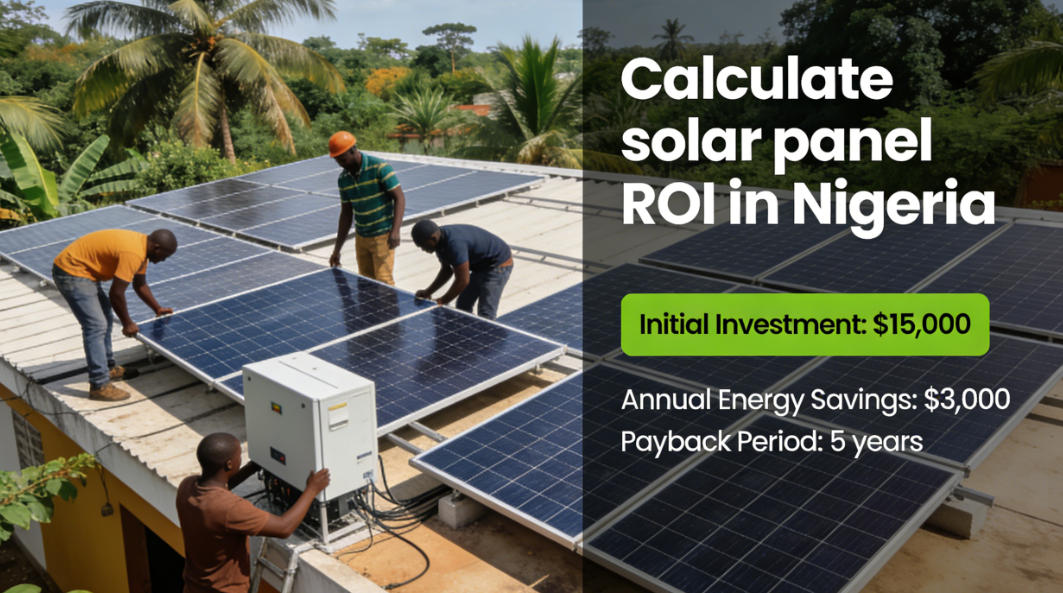 This new reality makes understanding your Solar Panel ROI more critical than ever. It’s no longer just about having power; it’s about the long-term financial health of your home or business. This article provides a deep dive into how to accurately calculate that return, moving beyond guesswork to a data-driven understanding of your investment.
The New Economics of Nigerian Power
To understand why solar ROI calculations have become so compelling, you have to look at the changing cost of the alternatives.
Before 2023, running a generator was often seen as the cheaper, if less convenient, option. That calculation has been obliterated. Petrol prices have jumped by nearly 500%, making daily generator use a prohibitively expensive habit for many households and small businesses. For commercial operations relying on diesel, the story is the same, with costs eating directly into profit margins and forcing some manufacturers to cut shifts.
Simultaneously, the cost of grid electricity for those who receive the most supply (Band A) was raised to ₦209.5/kWh. While the government has since adjusted this, the trajectory towards a more cost-reflective tariff is clear, and the days of artificially cheap electricity are numbered. The Nigerian power sector’s deep-seated liquidity crisis, with debts projected to hit ₦6 trillion, means pressure for further tariff adjustments will only grow.
In this volatile energy landscape, solar power offers something invaluable: predictability. A well-designed solar system allows you to lock in your electricity costs for the next 10 to 25 years, insulating you from the shocks of fuel price hikes and tariff reviews.
Deconstructing Solar ROI: Beyond a Simple Number
A return on investment (ROI) calculation for a solar panel system is more nuanced than a simple stock market return. It’s not about generating profit in the traditional sense; it’s about avoided costs. Your solar panels become a miniature power plant on your roof, generating electricity that you don’t have to buy from the grid or produce with expensive fuel.
A comprehensive solar ROI calculation for a Nigerian property must account for three core variables:
-
Your Consumable Energy: This is the foundation. You need an accurate picture of your daily energy consumption in kilowatt-hours (kWh). This isn’t just what’s on your generator log; it’s a detailed inventory of every light, fan, air conditioner, freezer, and appliance you power, and for how long each day.
-
Your Current Energy Cost (The Baseline): This is what you’re paying for the energy you currently use. For grid-tied users, it’s the applicable tariff (e.g., ₦65/kWh, ₦125/kWh, or the higher Band A rates). For generator users, it’s the cost of fuel (petrol or diesel) per kWh generated, plus the wear-and-tear and maintenance costs of the generator itself. This “cost of avoidance” is your baseline for calculating savings.
-
Your Solar Resource (The Fuel): Unlike a generator, your solar panels are fueled by the sun, which is free. However, the amount of “fuel” available varies dramatically across Nigeria. A system in Lagos will not generate the same amount of power as an identical system in Kano. This is determined by peak sun hours—the number of hours per day when solar irradiance averages 1,000 watts per square meter. Using location-specific solar irradiation data is essential for an accurate estimate.
Location, Location, Location: The Nigerian Solar Map
Nigeria is blessed with immense solar potential, but it’s not distributed evenly. The country receives an average solar radiation of about 5.5 kWh/m² per day, but this varies significantly from the coast to the Sahel.
Accurate ROI calculations must account for these regional differences. Research confirms that Northern Nigeria has a significantly higher solar yield. For instance, studies show the Northeast region has an annual mean global solar radiation of over 2,179 kWh/m², compared to lower figures in the North Central zone. This means a solar system in Kano can be smaller (and therefore cheaper) to generate the same amount of electricity as a larger, more expensive system needed in Port Harcourt.
This is why generic online calculators are often misleading. A robust calculation, like the one found on the Nigeria Solar ROI Calculator, integrates data for specific states, allowing you to estimate generation based on the real solar conditions at your location.
Running the Numbers: A Real-World Example
Let’s build a hypothetical but realistic scenario for a small business in Lagos to illustrate the calculation. We’ll use a baseline grid tariff of ₦65/kWh for simplicity, though many businesses are on higher bands or rely on generators.
-
Daily Consumption: 20 kWh
-
Location: Lagos (moderate irradiation)
Based on this, a preliminary system design from a calculator might suggest:
-
Solar PV Capacity: ~5 kWp
-
Battery Capacity: ~10 kWh (for basic backup and evening use)
-
Estimated System Cost: This could range from ₦4 million to ₦6 million depending on component quality (panels, inverter, battery type).
Now, let’s look at the savings.
-
Annual Grid Cost (without solar): 20 kWh/day * ₦65/kWh * 365 days = ₦474,500 per year.
-
Annual Solar Savings: A well-sized system in Lagos might cover 70-80% of this annual consumption, depending on sunlight and battery capacity. If it covers 75%, your annual savings would be approximately ₦355,875.
Finally, we arrive at the two most important metrics:
-
Simple Payback Period: This is the time it takes for your cumulative savings to equal your initial investment.
-
Payback = System Cost / Annual Savings
-
Payback = ₦5,000,000 / ₦355,875 ≈ 14 years.
-
This payback period might seem long, but it’s crucial to understand what it represents. First, this is a conservative estimate. If your current cost per kWh is higher (e.g., you use a diesel generator), your annual savings and payback period improve dramatically. A study in Oyo State found that a PV-Grid hybrid system offered the best economic value. Furthermore, a 14-year payback on a system with a 25-year lifespan means 11 years of nearly free electricity after the investment is recovered.
The Intangible Returns: The Value of Uptime
A purely financial ROI calculation misses a critical component of solar’s value, especially for Nigerian businesses: operational reliability. Manufacturers in industrial clusters like Amuwo-Odofin report monthly energy bills between ₦180 million and ₦220 million, but the bigger cost is lost productivity from outages. Unplanned downtime stops production, breaks supply chains, and damages equipment.
Solar power, particularly when paired with battery storage, provides a shield against this. It offers:
-
Predictable Operations: Run your business during daylight hours without worrying about grid drops or generator refueling.
-
Equipment Protection: Sensitive electronics and machinery are safeguarded from the voltage fluctuations and surges common with grid power and generators.
-
Peace of Mind: The cognitive load of constantly managing an unstable power supply is a hidden cost that solar eliminates.
For companies like Arnergy, the pitch has evolved from providing “uninterrupted power” to a clear financial proposition: “we can clearly show customers how our systems save them monthly”. This is the new math of Nigerian power.
Your Action Plan for Calculating an Accurate ROI
Ready to run the numbers for your own property? Don’t rely on guesswork. Follow these steps to get a reliable estimate of your potential solar ROI.
-
Audit Your Energy Use: Go through your electricity bills for the last 12 months to understand your average monthly and daily kWh consumption. If you primarily use a generator, track your fuel usage over a representative period.
-
Know Your Current Tariff: Determine exactly what you pay per kWh. Is it the subsidized rate for your band, or are you paying the full cost of diesel generation? This is your “avoided cost.”
-
Get Location-Specific Data: Use a tool that factors in the solar irradiation for your specific state. The Nigeria Solar ROI Calculator is an excellent starting point, as it integrates data for Lagos, Abuja, Kano, and many other states, providing a more accurate baseline for generation potential than a one-size-fits-all tool.
-
Get Multiple, Detailed Quotes: Use the output from the calculator—estimated system size in kWp and battery capacity in kWh—as a specification to get quotes from reputable installers. A detailed quote will break down the costs of panels, inverter, battery, mounting structures, wiring, and installation.
-
Calculate Your Personal Payback: With a firm quote in hand and a refined estimate of your annual savings, calculate your payback period. Ask installers for the projected levelized cost of energy (LCOE) for the system, which represents the cost per kWh over its lifetime. Academic studies on Nigerian systems have shown LCOEs can be highly competitive, around $0.07/kWh (approximately ₦105/kWh at current rates), which is far cheaper than generator power.
The decision to invest in solar is a major one. But by approaching it with a clear, data-driven framework for calculating ROI, you can move beyond the marketing hype and make a decision grounded in the real economics of your home or business. In a nation where the only constant in the energy sector is change, solar power offers a path to stability, savings, and true energy independence.