New Energy Expo in Nigeria 2026: The $1,220 Billion Gateway to West Africa
By West Africa Energy Desk · February 24, 2026
LAGOS — In a nation where over 60% of the population still lacks stable grid access and businesses lose an estimated $29 billion annually to power outages, the New Energy Expo in Nigeria has evolved from a mere trade show into the central nervous system of West Africa’s energy transition. As of February 2026, the expo landscape is more dynamic than ever. With the government targeting 30% renewable energy by 2030 and a national Electricity Act empowering states, these exhibitions are where policy meets procurement, and where Chinese Tier-1 banks, German innovators, and Nigerian off-grid champions close the deals that will power the continent’s largest economy. This deep-dive analyses the premier expo event of 2026—taking place 16–18 September 2026—and explains why it is indispensable for any company serious about the West African market.
The Premier Expo: Mapping the 2026 Calendar
Unlike mature markets where one mega-event dominates, Nigeria’s expo scene serves a distinct layer of the energy value chain. The anchor event, the New Energy Expo in Nigeria, is scheduled for 16–18 September 2026 at the Landmark Centre, Lagos. This is the largest and most established platform, now in its second decade, functioning as the regional sister of major international energy shows. For 2026, it promises over 500 exhibitors and extensive exhibition space, a significant jump from previous editions, reflecting the post-2025 investment surge. With a laser focus on the technologies “at the forefront of the transition to a greener, smarter, more decentralised energy system,” it attracted thousands of attendees and hundreds of exhibitors in its last edition and is projected to grow in 2026. It is the premier gathering for engineers, IPPs, and EPC contractors focused on utility-scale and C&I projects, bridging the gap between international green technology and West African implementation, with strong sessions on green finance, innovation, and sustainable energy solutions. Its B2B matchmaking format is particularly valued by international SMEs seeking local partners.
Beyond the Booths: What the September 2026 Expo Floor Reveals
Walking the floor of the New Energy Expo in Nigeria in September 2026, a visitor would immediately notice a fundamental shift. Gone are the days when exhibitions were dominated by diesel generator reps and a handful of solar lantern distributors. Today, the floor is a battlefield of integrated solutions.
The Chinese manufacturing presence has matured. Giants like LONGi, JinkoSolar, and Trina are no longer just handing out brochures; they are co-exhibiting with local Nigerian assemblers, showcasing modules specifically tested for high ambient temperatures and harmattan dust. In 2025, LONGi leveraged the expo to announce a 200 MW supply deal for a solar park in the North, while Jinko used the platform to finalise an agreement with a Lagos free-trade zone.
Equally striking is the emergence of homegrown Nigerian technology champions. Companies like Arnergy and Salpha Energy, which have raised significant local and international funding, use this expo to launch products designed for Nigerian price points and usage patterns. They are joined by inverter giants like GoodWe and Sungrow, who now consider the Nigerian expo circuit essential for after-sales service networking and installer training. The integration of lithium battery storage is omnipresent; with Nigeria’s lithium-ion imports from China surging 65% in 2024, every major booth now features a sleek hybrid inverter paired with a wall-mounted battery.
The Policy-Innovation Nexus: Why You Cannot Afford to Miss It
The true value of the New Energy Expo in Nigeria lies in its conference halls. These are not mere talking shops; they are where the real-time interpretation of the Electricity Act 2023 happens. At the September 2026 conference, attendees will hear directly from the Rural Electrification Agency (REA) on the rollout of the next phase of the DARES programme (Distributed Access through Renewable Energy Scale-up), which is backed by a $750 million World Bank facility. Discussions will centre on the new performance-based grants that favour local content and assembly.
With the Nigerian Sovereign Investment Authority (NSIA) increasingly active, and private equity funds scouting for projects, the expo floor has become a de facto due diligence arena. In 2026, expect standing-room-only sessions on microgrid optimisation and the use of AI in managing C&I energy loads, along with deep technical workshops that differentiate this event from others.
Market Numbers That Drive the Expo Boom
The exponential growth of this expo is underpinned by staggering market fundamentals. The African Development Bank estimates Nigeria’s power infrastructure investment gap at $1,220 billion, with rural electrification alone accounting for over 40% of that need. This is not abstract demand. Consider these statistics that every exhibitor in September 2026 is chasing:
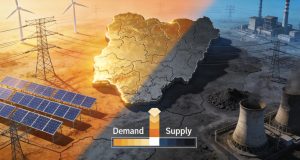
- Installed generation capacity hovers around 4.5 GW for a population exceeding 220 million, while actual demand is estimated at over 20 GW.
- 80% of industrial companies rely entirely on self-generation, mostly expensive diesel, spending between $0.40 and $0.60 per kWh — a rate at which solar-plus-storage pays back in under three years.
- The federal target of 30% renewable energy by 2030 implies the deployment of thousands of megawatts of new solar and wind capacity over the next four years.
- Government policies now include import duty waivers on solar components and tax incentives for manufacturers, making local assembly financially viable for the first time.
The September 2026 Verdict: From Exhibition to Ecosystem
The New Energy Expo in Nigeria is no longer a peripheral event for early adopters. In September 2026, it is the central marketplace where the country’s energy future is being physically constructed. The data is compelling: at the 2025 edition, Chinese exhibitors alone reportedly signed deals worth over $300 million. The 2026 numbers are expected to be significantly higher.
For an international company, attending or exhibiting at this event is the most efficient path to market intelligence, regulatory clarity, and bankable partnerships. For Nigerian firms, it is a chance to demonstrate that local innovation can compete with global giants. As the lines between traditional and renewable energy blur, and as the urgency of energy access collides with climate imperatives, this expo provides the only reliable map through the complexity. It is, in essence, the beating heart of West Africa’s energy transition taking place 16–18 September 2026.