Official Reference for NNEPIE 2026 | Lagos, Nigeria
Welcome to Nigeria! As an exhibitor or industry professional attending the Nigeria International New Energy and Power Industry Expo (NNEPIE 2026) , understanding local electrical standards is your first step toward a smooth, professional setup. This comprehensive guide delivers everything you need—from plug types and voltage reality to country-by-country comparisons—all tailored for the Nigerian market.
🇳🇬 Nigeria at a Glance: Official Electrical Standards
Before you pack a single cable, memorize these Nigerian national standards:
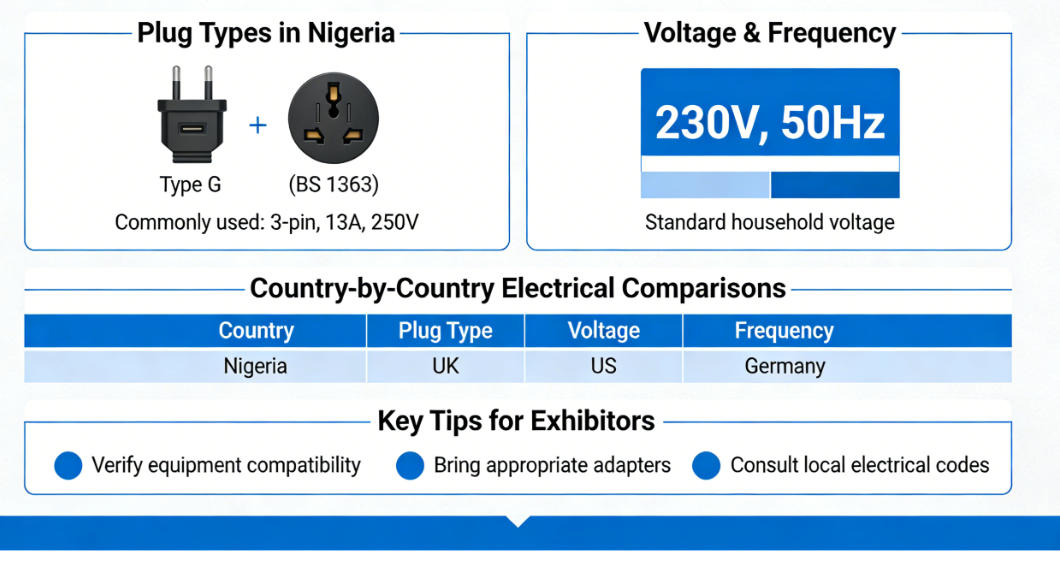
Voltage: 230V / Frequency: 50Hz / Primary Plug Types: Type D & Type G
| Critical Parameter | Nigerian Standard | Why It Matters for Exhibitors |
|---|---|---|
| Standard Voltage | 230 V (single-phase) 415 V (three-phase) |
Grid voltage can fluctuate. Automatic Voltage Regulators (AVRs) are highly recommended for sensitive demo equipment. |
| Frequency | 50 Hz | All motors, timers, and electronic displays must be rated for 50Hz. 60Hz equipment may overheat or malfunction. |
| Primary Plug Types | Type D (3-round-pin, old standard) Type G (3-rectangular-pin, current standard) |
Type G dominates in modern buildings, hotels, and the Landmark Centre. Type D appears in older infrastructure. |
| Mandatory Certification | SONCAP (all electrical goods) NEMSA (power-specific equipment) |
Some power generation or transmission equipment may require additional approval from the Nigerian Electricity Management Services Agency (NEMSA) . |
⚡ Critical Note: Voltage Stability & Pro Tips
Nigeria’s power grid, while rapidly developing, can experience fluctuations (surges and drops). For high-value exhibits or critical demonstrations:
-
Bring Automatic Voltage Regulators (AVRs) – Protect sensitive electronics from damaging voltage spikes.
-
Use Uninterruptible Power Supplies (UPS) – Ensure your booth’s presentations and point-of-sale systems stay live during brief outages.
-
Consult Your Logistics Partner – Experienced organizers like VanSon Exhibition provide invaluable, on-the-ground advice about power arrangements specific to the Landmark Centre.
🌍 African Regional Electrical Standards Reference
Understanding your neighbors’ standards is key, especially if you’re networking at the West Africa Power Summit co-located with NNEPIE.
| Country | Common Voltage (V) | Frequency (Hz) | Primary Plug Types | Notes for Travelers/Exhibitors |
|---|---|---|---|---|
| 🇳🇬 Nigeria | 230 | 50 | D, G | Type G is your safe bet for all modern venues. |
| 🇬🇭 Ghana | 230 | 50 | D, G | Virtually identical to Nigeria; excellent for cross-border logistics planning. |
| 🇰🇪 Kenya | 240 | 50 | G, B, C | Largely British-influenced standards; Type G common. |
| 🇿🇦 South Africa | 230 | 50 | C, M, N | Unique Type M (large 3-round-pin). If bringing SA equipment, pack adapters. |
| 🇪🇬 Egypt | 220 | 50 | C, F | Leans toward European (Type F/Schuko) standards. |
🌐 Global Electrical Standards (Key Exhibiting Countries)
NNEPIE 2026 hosts exhibitors from over 28 countries and regions. Here’s how their standards compare to Nigeria’s:
Asia & Middle East
| Country/Region | Voltage (V) | Plug Types | Compatibility with Nigeria |
|---|---|---|---|
| 🇨🇳 China | 220 | A, C, I | Not compatible – requires a Type G plug adapter. Voltage is very close, so no transformer needed. |
| 🇮🇳 India | 230 | C, D, M | Partially compatible – Type D plugs will fit Nigerian Type D sockets. Bring adapters for Type C/M. |
| 🇰🇷 South Korea | 220 | C, F | Not compatible – requires a plug adapter (to Type G). |
| 🇯🇵 Japan | 100 | A, B | Incompatible – needs both a step-down transformer (100V → 230V) and a plug adapter. |
| 🇦🇪 UAE | 220 | C, D, G | Highly compatible – Type G devices work perfectly. |
Europe & Americas
| Country/Region | Voltage (V) | Plug Types | Compatibility with Nigeria |
|---|---|---|---|
| 🇩🇪 Germany | 230 | C, F | Voltage compatible, plug incompatible – needs a simple Type F to Type G adapter. |
| 🇬🇧 United Kingdom | 230 | G | Fully compatible – same voltage, frequency, and plug (Type G). Easiest transition. |
| 🇺🇸 United States | 120 | A, B | Completely incompatible – requires both a step-up transformer (120V → 230V) and a plug adapter. |
| 🇫🇷 France | 230 | E | Voltage compatible, plug incompatible – needs a Type E to Type G adapter. |
🔌 Plug Type Visual Guide: Identify & Adapt
At the expo or during site visits, you’ll encounter these plug types. Know them at a glance:
-
Type D (BS 546) : Three round pins in a triangle. Found in older buildings and some heavy-duty equipment from India or South Africa.
-
Type G (BS 1363) : Three rectangular pins. This is the modern Nigerian standard. If your device comes from the UK, Singapore, Malaysia, or the UAE, it likely has this plug.
-
Type C (Europlug) : Two round pins. Common across Europe and Asia. Fits into many Type G sockets (which often have two round holes), but grounding is lost—safe for low-power devices like phone chargers.
-
Type F (Schuko) : Two round pins with side grounding clips. Common in Germany and Spain. Requires an adapter for Type G sockets.
💡 Exhibitor Action Tips: Power Preparedness
-
Stock Up on Adapters: For every piece of Chinese-standard (A, C, I) equipment, bring multiple high-quality “Type G” (UK standard) universal adapters.
-
Replace, Don’t Just Adapt (for critical gear): For servers, medical displays, or continuous-run demos, consider replacing the power cord with one that has a molded Type G plug. This provides a more secure, grounded connection.
-
Bring a Power Strip: A universal socket power strip plugged into a single Type G adapter lets you power multiple devices (laptop, monitor, phone charger) from one outlet—essential for a tidy booth.
-
Label Everything: Use colored tape or cable ties to mark your power cords. This saves hours during teardown and prevents leaving expensive cables behind.
✅ Pre-Departure Electrical Checklist for Exhibitors
-
1. Audit Every Device: Check the input label on all equipment. Does it support 230V / 50Hz? If not, purchase the correctly rated step-up or step-down transformer.
-
2. Calculate Total Wattage: Ensure your transformer(s) and power strips have a maximum wattage 20% higher than the combined load of everything plugged into them.
-
3. Procure Quality Adapters: Buy Type G (UK standard) universal adapters. Quantity rule: (number of devices × 1.5) + 2 spares.
-
4. Contact Your Organizer: Reach out to VanSon Exhibition for the latest advice on SONCAP exemptions for temporary imports or customs clearance for exhibition equipment.
-
5. Plan for Backups: Pack a small multimeter and a few basic tools. Knowing how to test voltage at your booth outlet gives you immediate confidence.
Mastering local electrical standards is a mark of professionalism. We look forward to welcoming you to the Landmark Centre in Lagos from September 16-18, 2026, where you’ll connect with the future of Nigeria’s and West Africa’s energy landscape. Plan your power, and focus on your business.