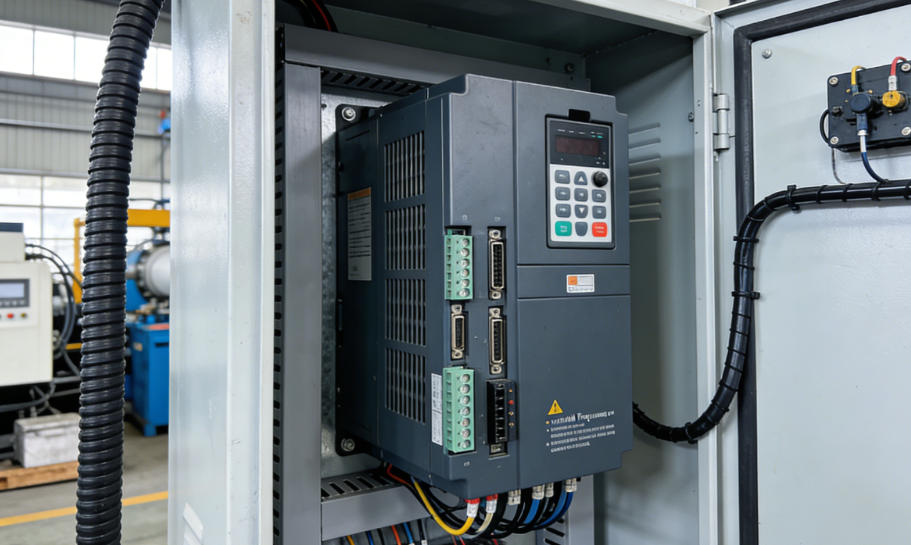
Walk through any modern industrial facility, and you’ll hear it before you see it—the hum of electric motors powering pumps, fans, compressors, and conveyors. These workhorses of industry consume an astonishing amount of energy. According to the U.S. Department of Energy, motor-driven equipment accounts for well over half of the electricity used by American industry. Globally, electric motors and motor systems in industrial and infrastructure applications are responsible for more than 50% of the world’s total electricity consumption. Behind the scenes, silently optimizing every kilowatt, sits one of the most transformative yet underappreciated technologies in modern engineering: the variable frequency speed drive.
Beyond On and Off: Rethinking How Motors Work
To appreciate the genius of variable frequency speed drive technology, one must first understand the problem it solves. Traditional industrial motors are designed to run at one fixed speed—typically 1,500 or 3,000 rpm—determined by the mains frequency and the motor’s construction. For decades, when processes demanded less flow or pressure, engineers resorted to crude workarounds: throttling valves, damping fans, or recycling fluids through bypass lines. These methods are the mechanical equivalent of driving a car with the accelerator floored while controlling speed with the brakes. They work, but they waste enormous energy.
A variable frequency drive (VFD) , also commonly called a variable speed drive or AC drive, fundamentally changes this paradigm. It sits between the electrical supply and the motor, acting as a sophisticated power regulator. Inside the drive, incoming AC power is converted to DC through a rectifier, smoothed by capacitors, and then inverted back to AC at precisely the frequency and voltage the motor needs at that exact moment. This allows the motor to run at exactly the speed required by the process—no faster, no slower.
The Affinity Laws: Where Physics Delivers Profits
The true magic of variable frequency speed drive technology lies not in complex circuitry, but in fundamental physics. For centrifugal loads like pumps and fans—which represent the vast majority of industrial motor applications—the affinity laws govern performance. These laws state that the power required to run a pump or fan is proportional to the cube of its speed.
This relationship is staggering in its implications. Reducing motor speed by just 25% lowers energy consumption by approximately 60%. Cut the speed in half, and energy usage plummets by nearly 90%. In practical terms, this means a pump running at 80% speed consumes roughly half the energy of one running at full speed while still delivering adequate flow. This is not incremental improvement; it is transformative efficiency.
Consider the numbers. A typical 150 kW (200 Hp) industrial motor can consume electricity equivalent to its capital cost in just three months of operation . Over a 20-year lifespan, more than 90% of the total cost of ownership for that motor is the energy it consumes. When viewed through this lens, investing in variable frequency speed drive technology is not an expense—it is one of the highest-return investments a facility can make.
Real-World Impact: Moving Beyond Theory to Tangible Results
The theoretical efficiency gains of VFDs are compelling, but their real-world performance in demanding industrial environments is what truly validates the technology. Recent case studies from across the globe demonstrate that these devices deliver exactly what the physics promises.
Mining Ventilation: Saving Lives and Energy Simultaneously
In the gold mines of South Africa, ventilation is not optional—it is a matter of life and death. Deep underground mines require massive fans to ensure adequate airflow for workers. Traditionally, these fans ran at full speed constantly, with redundant units standing by in case of failure. The energy costs were enormous.
Energy Drive, a firm specializing in industrial energy efficiency, partnered with Sibanye-Stillwater, a multinational mining company, to rethink this approach. They installed Rockwell Automation PowerFlex® 6000T VFDs on the large surface ventilation fans at two gold mines. The solution was elegantly simple: rather than running one fan at full speed with another idling, they ran both fans simultaneously at reduced speeds controlled by VFDs. If one fan encountered a problem, the system automatically ramped up the other to maintain safe airflow.
The results were extraordinary. The first shaft achieved average energy savings of 62%, while the second delivered 48%. Over the contract term, the three upgraded shafts are projected to save approximately 360 gigawatt-hours of energy—equivalent to powering 5,000 South African homes monthly. The carbon reduction: 379,000 tons. Beyond the numbers, the system enhanced miner safety through 24/7 monitoring and automated failure response.
Oil and Gas: Regenerating Energy from Thin Air
In North Dakota’s oil fields, another innovation is unfolding. A global energy company faced aging infrastructure, with variable frequency drives that had been operating for over a decade. These older drives used dynamic braking resistors, which wasted excess energy by dissipating it as heat . The company partnered with DSI, an electrical integration firm, and Rockwell Automation to deploy PowerFlex® 755TR regenerative drives.
Unlike conventional drives, regenerative drives can capture energy produced when loads are overhauling—such as when a pump jack is lowering a rod string—and feed it back into the power system. The pilot project at three wells demonstrated that 17% of the energy used could be regenerated, with 95% of that recovered power reused within the facility. Once full deployment across 1,200 wells is completed, the company projects $3 million in monthly energy savings.
Precision Control in Complex Environments
Beyond raw energy savings, variable frequency speed drive technology enables levels of process control that are simply impossible with fixed-speed motors and mechanical throttling. Modern VFDs incorporate sophisticated algorithms and closed-loop control capabilities that transform how industrial processes operate.
HVAC Systems: Matching Supply to Demand
Commercial building HVAC systems are notoriously oversized, designed to handle peak loads that occur only rarely. Without VFDs, fans and pumps run at constant speed, with cooling or heating adjusted by dumping excess capacity. This approach wastes energy and creates comfort inconsistencies.
Modern VFDs designed specifically for HVAC applications, such as Schneider Electric’s ATV61 and ATV212 series, incorporate features tailored to building needs. These drives include built-in PID controllers that automatically adjust fan or pump speed based on real-time sensor readings—pressure differentials, temperature differentials, or flow rates. They can coordinate multiple pumps, automatically rotating lead and lag units to balance wear, and implement sleep/wake functions that shut down equipment when demand disappears.
The ATV212 series, optimized for Variable Air Volume (VAV) terminal fans, achieves airflow accuracy within ±1% while reducing harmonic distortion to below 35%. For hospitals, data centers, and laboratories where precise environmental control is critical, this level of performance is not merely convenient—it is essential.
Water and Wastewater: Extending Infrastructure Life
Pumping systems in water treatment plants and irrigation networks face constantly varying demand. Without speed control, pumps cycle on and off frequently, subjecting motors and piping to damaging pressure surges—water hammer—that accelerates wear and risks catastrophic failures. VFDs enable soft starting and stopping, gradually ramping speed up and down to eliminate pressure transients. This extends equipment life while reducing maintenance costs.
The Evolution of Drive Technology: Smarter, Smaller, More Capable
Variable frequency speed drive technology has not stood still. Recent innovations are pushing the boundaries of what these devices can achieve, making them even more attractive for industrial applications.
Active Energy Control: Extracting Every Possible Watt
Eaton has introduced a patented algorithm called Active Energy Control, available on its PowerXL and H-MAX series drives. This technology continuously monitors output power performance while actively reducing input power requirements for variable torque loads. According to Eaton, Active Energy Control delivers industry-leading energy savings of up to 10% beyond what conventional VFDs achieve. For facilities operating hundreds of drives—hospitals, for example, may have hundreds installed across their campuses—these incremental savings compound into substantial bottom-line impact.
Sync-Transfer Control: One Drive, Multiple Motors
Traditional VFD architecture follows a one-to-one model: one drive per motor. Rockwell Automation has pioneered an alternative approach using sync-transfer control with medium voltage drives. In this configuration, a single VFD can selectively control multiple motors, one at a time. The drive brings a motor up to speed, synchronizes it with the utility supply, and then transfers operation to the direct line while moving to control another motor. This approach can reduce capital costs by up to 50% while providing built-in redundancy. For pipeline stations with multiple pumps in series, this architecture maximizes asset utilization while minimizing equipment footprint.
Smart Motors: Embedding Intelligence
ITT’s VIDAR represents an even more radical departure: embedding variable-frequency intelligence directly into the motor itself. Using patented AC-Link technology, VIDAR replaces conventional AC-DC-AC conversion with a streamlined AC-AC approach, eliminating bulky capacitors and shrinking the drive by 60%. The result fits into the footprint of a conventional motor while delivering the same 50% energy savings as traditional VFD systems. For applications where space is at a premium or where adding external drives would complicate installation, this integrated approach offers compelling advantages.
The Maintenance Imperative: Protecting the Investment
While variable frequency speed drive technology delivers exceptional returns, these devices are not “install and forget” components. They contain sensitive electronics, cooling fans, and filters that require periodic attention. According to the Pacific Northwest National Laboratory, proper operations and maintenance of VFD systems is essential to optimize performance and achieve reliable, high efficiency throughout their life cycles.
Key maintenance practices include maintaining proper ambient conditions—VFDs have critical temperature and humidity ranges for reliable operation—and protecting them from dust and airborne particulates. Many facilities house drives in climate-controlled areas separate from the motors they control. Regular inspection of cooling fans and filters, verification of parameter settings, and thermal imaging to detect developing problems can prevent unexpected failures.
Modern VFDs increasingly include network connectivity that enables continuous monitoring through building automation systems or dedicated software. Trending output frequency, amperage draw, and energy consumption over time provides early warning of developing issues—a pump bearing beginning to fail, for example, may show up as increased current draw before catastrophic failure occurs.
The Sustainability Connection: Drives as Climate Solutions
As corporations and governments commit to ambitious carbon reduction targets, variable frequency speed drive technology has emerged as a critical tool for achieving sustainability goals affordably. Unlike many green technologies that require significant capital investment with long payback periods, VFDs often pay for themselves in months through energy savings alone.
James Hynd, CEO of Energy Drive, articulates this value proposition clearly: “Ultimately what we do is deliver energy savings and with that we deliver carbon reduction. It’s the right thing to do and for that to be achieved at not just low cost, but at a net savings is quite significant” .
For companies subject to carbon pricing or seeking to generate carbon credits, VFD installations offer documented, verifiable emissions reductions. The Rockwell Automation case study documented not only energy savings but also the corresponding reduction in water consumption and coal usage at the power plants that would otherwise have generated that electricity. This holistic view of sustainability—reducing resource consumption across multiple dimensions—represents the future of industrial environmental responsibility.
Applications Across Industries
The versatility of variable frequency speed drive technology means it delivers value across virtually every industrial sector:
-
Mining: Ventilation fans, pumps, conveyors, crushers
-
Oil and Gas: Pipeline pumps, compressor stations, wellhead equipment
-
Water/Wastewater: Treatment plant pumps, irrigation systems, lift stations
-
HVAC: Air handlers, cooling towers, chillers, VAV boxes
-
Manufacturing: Conveyors, mixers, extruders, machine tools
-
Food Processing: Pumps for liquids, fans for drying, conveyors for packaging
-
Data Centers: Cooling fans and pumps for server rooms
In each application, the fundamental value proposition remains consistent: match energy input precisely to process requirements, eliminate waste, and extend equipment life through gentler operation.
The Future: Intelligent, Connected, Predictive
Looking ahead, variable frequency speed drive technology will become increasingly intelligent and connected. Modern VFDs already generate rich real-time data about motor performance, energy consumption, and system conditions. When combined with analytics platforms like Rockwell Automation’s FactoryTalk® Analytics™ GuardianAI™, this data enables predictive maintenance. The system can identify developing issues—flow restrictions, cavitation, loose mounting, bearing faults—before they cause downtime, and notify maintenance personnel with probable causes and recommended actions.
For large facilities with hundreds of motors, this predictive capability transforms maintenance from reactive firefighting to proactive optimization. The same VFDs that save energy also become the nervous system of the industrial facility, continuously monitoring equipment health and optimizing performance.
The Quiet Revolution
Variable frequency speed drive technology lacks the glamour of solar panels or electric vehicles. It does not appear in headlines or capture public imagination. Yet in the quiet hum of thousands of motors running precisely at the speed required—no faster, no slower—it delivers one of the most potent combinations of economic and environmental benefit available to modern industry.
For facilities managers facing pressure to reduce costs, for sustainability officers chasing carbon reduction targets, and for engineers seeking to optimize process performance, VFDs offer a proven, reliable, and rapidly payback solution. The technology has matured over four decades, evolved through multiple generations of innovation, and demonstrated its value across every conceivable industrial application.
As global attention focuses on energy efficiency as the “first fuel”—the cheapest, fastest, and cleanest way to meet energy demand—variable frequency drives stand ready to deliver. They are, quite simply, one of the most important technologies that most people have never heard of. And that is exactly how it should be: quietly, efficiently, invisibly, doing the work that keeps the modern world running.