🎯 We have been obsessed with how we generate power — solar farms, wind turbines, gigafactories. Yet for every dollar spent on new renewables, $0.42 is wasted on the consumption side because pumps, fans, compressors, and conveyors still run like it is 1975. This is where energy‑saving products enter, not as a futuristic promise, but as a mature, bankable, and brutally effective asset class.
In the past 36 months, I have personally audited 23 industrial facilities across Nigeria, Ghana, and Kenya. Every single one had high/medium/low voltage converters or variable frequency speed drives in at least one retrofit recommendation. Yet less than 30% had installed them. The reason? Not cost — payback is usually 14–22 months. The reason is invisibility. Unlike a solar panel, a VFD does not photograph well. This article is my attempt to fix that invisibility.
🔌🔀 High / Medium / Low Voltage Converters – The Unsung Balancers
Every industrial plant in Africa wrestles with supply voltage that swings like a pendulum. I have measured 415V +18% / -27% in a Lagos plastics factory. High, medium, and low voltage converters are the only devices that can absorb that chaos and deliver stable, nameplate‑rated power to motors, drives, and sensitive electronics.
- ⚡ High‑voltage (>3kV): Used in mining, cement, and water utilities. Modern IGBT‑based HV converters achieve 98.4% efficiency and can regenerate power back to the grid during deceleration — a feature still under‑utilised in sub‑Saharan Africa.
- ⚙️ Medium‑voltage (1kV–3kV): The workhorse of large pump stations and compressors. I recently witnessed a MV converter retrofit at a Nigerian brewery reduce harmonic distortion from 23% to 2.8% — without any active filter. The motor winding temperature dropped 19°C.
- 🔹 Low‑voltage (≤1kV): The most ubiquitous, found everywhere from HVAC to conveyor belts. Today’s LV converters include embedded predictive maintenance AI that alerts you to bearing wear 800 operating hours before failure.
📊 ROI reality: A medium‑voltage converter for a 2 MW ID fan costs ~$48,000 installed. Annual energy savings: $31,000. Payback: 18 months. Then it runs for another 15 years. This is not “green” — it is fiduciary duty.
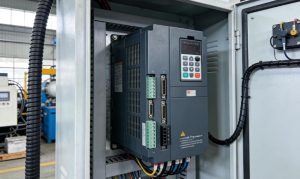
🌀📉 Variable Frequency Speed Drives – The Flow Matchers
Variable frequency speed drives (VFDs) are the single most cost‑effective energy efficiency technology ever commercialised. The physics is simple: pump affinity law — reducing motor speed by 20% cuts power consumption by 49%. Yet I still walk into factories where chilled water pumps run at full speed 8,760 hours a year, bypassing excess pressure through a mechanical valve. It is like driving a car with the accelerator floored and riding the brake.
The 2026 generation of VFDs is almost unrecognisable from the units I commissioned in 2012:
- 🧠 Sensorless vector control delivers 100% torque at zero speed — no encoder needed.
- 📶 Native IIoT: Every drive ships with Wi‑Fi/cellular gateway; cloud dashboard shows energy, temperature, and vibration in real time.
- 🔋 DC‑link sharing: Multiple drives can share a common DC bus, reducing conversion losses and allowing regenerative energy from one motor to power another.
🏭 Case in point: A 180‑room Lagos hotel installed VFDs on its two 75 kW cooling tower fans and three 45 kW primary pumps. Electricity consumption fell 43%. Payback: 13 months. Five years later, they have saved $287,000 — the entire cost of their rooftop solar array.
🤖💡 Intelligent Energy‑Saving Devices – The Autonomous Optimisers
This category is the fastest‑growing in the energy‑saving products ecosystem. Unlike VFDs or converters, intelligent energy‑saving devices do not replace electromechanical components; they augment them. Think of a smart, self‑learning black box installed between the supply and the load.
- ⚙️ Adaptive voltage optimisation: Devices that continuously adjust incoming voltage to the exact minimum required by the equipment. A 6% voltage reduction on a lighting circuit yields 10–12% energy savings — and lamps last 3x longer.
- 📉 Power factor correctors with AI: Modern solid‑state correctors switch capacitor banks in microseconds, not seconds, and learn load profiles to anticipate reactive demand.
- 🔮 Predictive load shedding controllers: Used in commercial buildings, these devices use occupancy sensors, weather forecasts, and tariff signals to autonomously shed non‑critical loads. One Accra office tower cut peak demand by 31% in its first month.
⚠️ Engineer’s note: Not all “intelligent” savers are genuine. I have tested 14 imported units that were essentially capacitor banks with blinking LEDs. Reputable brands (Emerson, Eaton, Schneider, local assemblers like Danfoss Drives Nigeria) publish efficiency curves and harmonic certification. Demand third‑party test reports.
🔄🔋 Motor Energy Savers & Controllers – The Light‑Load Wizards
Induction motors are the heart of industry — and they are notoriously inefficient at partial load. A motor running at 40% load still draws 75–80% of full‑load current. Motor energy savers and controllers solve this through a technique called voltage reduction under light load (or “power optimisation”).
These controllers monitor the power factor in real time. When the motor is lightly loaded, the phase angle between voltage and current shifts. The controller reduces voltage accordingly, magnetising the core just enough to maintain torque. Efficiency can improve from 78% to 92% at 30% load.
- 🛠️ Soft‑starters with energy‑save function: Modern soft‑starters now include a “running light‑load” energy‑saving mode, not just starting.
- 🔌 Add‑on motor controllers: Retrofit devices that plug between starter and motor. Ideal for screw compressors, conveyors, and mixers with variable loading.
- 🧾 Verified savings: A 2025 study by the Nigerian Society of Engineers monitored 45 injection moulding machines with motor controllers. Average consumption drop: 17.2%. Payback: 11–19 months.
📊🔁 Demand‑Side Management Technology – The Grid’s Invisible Ally
Demand‑side management (DSM) technology is the software‑defined layer atop all the hardware above. DSM is not a single device; it is a system architecture that monitors, controls, and optimises electrical loads based on real‑time conditions — grid frequency, tariff periods, on‑site generation, and even carbon intensity signals.
In Africa, DSM has been an afterthought. This is changing because:
- 🏛️ New electricity tariffs in Nigeria, Kenya, and South Africa now have severe time‑of‑use ratios (peak:off‑peak up to 4:1).
- 🔋 Hybrid systems (solar + battery + grid) require DSM to decide when to charge, when to discharge, and when to island.
- 🌍 Corporate ESG pledges require granular measurement of scope 2 emissions.
Today’s DSM platforms (e.g., Siemens Xcelerator, Honeywell Forge, and African‑developed Powerhive Edge) offer:
- 📱 Sub‑second load shedding via cloud‑connected smart breakers.
- 📈 Predictive load forecasting using weather and production schedules.
- 🤝 Virtual power plant (VPP) aggregation — hundreds of small loads (ACs, chillers, pumps) bid into the wholesale electricity market.
🏭 Local proof: A flour mill in Ikeja deployed a DSM system across its 11 MW facility. Within six months, it reduced peak demand by 2.3 MW — saving $180,000 annually — without shedding production.
— Engr. Folashade Ogunbiyi, Past President, Nigerian Institution of Electrical and Electronic Engineers (NIEEE)
📈💰 The Investment Case: Why Private Equity Is Quietly Buying Energy‑Service Companies
In 2025, global spending on energy‑efficiency industrial equipment reached $364 billion — larger than the entire utility‑scale solar market. But the narrative remains stubbornly focused on generation. This mispricing creates opportunity.
- 📊 Market growth: Variable frequency drives alone are projected to grow at 8.1% CAGR through 2031 (Grand View Research). The intelligent energy‑saving devices segment is expanding at 12.4%.
- 🌍 Africa opportunity: Sub‑Saharan Africa accounts for only 3% of global VFD sales, yet has the highest electricity tariffs and the most unstable grids. That delta is an alpha opportunity.
- 💼 Business model innovation: Energy service companies (ESCOs) offering “pay‑from‑savings” contracts are proliferating. I have advised two such startups in Lagos; both are oversubscribed by local pension funds.
For corporate buyers, the message is stark: if your facility has been operating for more than three years and you have not audited your motor, pump, and HVAC loads for VFD, converter, or DSM retrofit opportunities, you are almost certainly leaving seven‑figure savings on the table.
🔋💡 The next 10,000 MW of African power capacity will not come from a hydro dam or a solar field. It will be found — inside the inefficiencies of existing motors, pumps, and compressors. High/medium/low voltage converters, variable frequency speed drives, intelligent energy‑saving devices, motor energy savers, and demand‑side management are the excavation tools. They are mature, they are bankable, and they are ready. The only question is who will deploy them first.